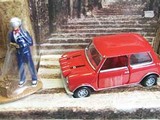


Mini Cooper Identification Guide
Use this guide to determine the originality and authenticity of various Mini Cooper models. For a complete guide to how to tell whether a Cooper is genuine, and the time it was made, see Original Mini Cooper and Cooper S by John Parnell - the definitive Cooper identification guide.
|
|
Note that blank chassis plates are widely available and can be stamped with any forged chassis number.
Paintwork
Mini Coopers were never painted red with a white roof, or British Racing Green with a white roof, and bonnet stripes were never a factory option. These features were restricted to works competition cars. Any car displaying these colours has, at the least, had a respray in the wrong colours. Non-works cars with a race history were often painted to these and other non-standard specifications, and retain their value by keeping these colours.
Also, not all Coopers were delivered with the roof painted a contrasting colour, and some Mk1 Super Mini saloons were sold with contrasting roof paint. The Mk 3 Cooper S was never sold with a contrasting roof colour.
The original colour may be determined by looking inside the car, unless the respray was very thorough. Areas include: inside the engine bay, the floor, underneath the front dash panel, and behind the front dash trim.
Since 1990, the reintroduced Rover Mini Cooper has been available in a variety of colours, including red or metallic British Racing Green with a white roof and bonnet stripes, optionally featuring John Cooper autographs.
Bodywork
There are a number of subtle differences between Cooper and standard Mini body work:
- Gear lever: All British Mark 1 and Mark 2 Coopers have two gear lever holes - one for the Mini 'magic wand' gear lever at the front of the floor-pan, and one for the remote change lever in front of the hand brake. The 'magic wand' hole is covered with a pressed-steel plate which is sealed and screwed in. Both gear lever holes are made as part of the floor-pan pressing process and are very difficult to fake as it is difficult to cut the holes as neatly as in the factory pressing. The remote change hole can easily be inspected by unscrewing the gear lever boot surround.
- Boot floor: There are several brackets to support the boot board - these were riveted in place until 1966, from which time they were spot-welded in place.
- Window trim: Front and rear side windows on all Coopers are trimmed in chrome (stainless steel on later cars.)
- Front panel: Later Cooper S models may be fitted with a modified front panel pressing designed to accommodate an oil cooler. This front panel features a grille stay that is tilted on an angle, rather than the standard Mini vertical stay.
- Opening rear windows: Standard Mk1 saloons had non-opening rear windows (though deluxe models had opening rear windows as well.)
- External door hinges and sliding windows: The key identifier of a Mk1/2 model. This is the easiest way to avoid being fooled by a "Cooper" based on a 1970's car.
- The floorpan should have 21 hydrolastic pipe clips spot welded to it, if a hydrolastic model.
- The rear of the car should have reinforced bump stop contact areas and extra reinforcing in the boot if hydrolastic.
- Cooper S models should have factory-drilled holes in the inner wing for the brake servo mounts, and also in the boot area for the right-hand tank mounts. Non-S Coopers did not have these holes.
- Two metal straps should be visible on the rear bulkhead from inside the car on twin-tank models. These are part of the restraint for the right hand fuel tank.
- All models should have a radiator shroud welded to the inner wing.
Engine
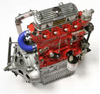
A genuine Cooper S 1275cc engine can be identified by the two tappet chest covers on the rear of the block, in common with the small-bore engines. It has an extra cylinder stud and cylinder bolt visible outside the rocker cover, and the rocker cover has two small cutouts to accommodate the stud and bolt. Drilling of non-Cooper S cylinder heads to "11 stud" spec is common in performance applications.
Non-Cooper S 1275cc engines are identified by the lack of tappet chest covers, the area being solid for improved engine rigidity. The S engine should also have a duplex timing chain. Some export 1275cc engines may have had the solid tappet chest covers common to non-Mini 1275cc engines (e.g. in the Austin/Morris 1300,) though this has not been confirmed.
The engine number prefixes below give a guide to originality though these are often lost if the block is hot tanked before reconditioning, as the alloy number tag would be dissolved in the tank.
|
The engine number tag is found on the top front right hand side of the engine block, immediately in front of the cylinder head. The suffix H stands for high compression, and L for low compression ratio. Be aware that blank engine tags are readily available and easily forged with the correct engine number for the car, information which is available from British Motor Heritage. Also, engine tags are often removed prior to reconditioning as they are made of alloy and will dissolve if the block is cleaned by hot tanking. A non-reconditioned engine should still have its engine tag.
All cars sold in Australia have an engine number stamped into the flat area where the tag is mounted, to comply with Australian law. This number may have been assigned by Australian authorities and bear no relation to the actual engine number.Interior Trim
Not all Mk1 Coopers were supplied with gold brocade trim. Cars with plain grey trim were painted Smoke Grey/Old English White roof, Almond Green/Dove Grey roof, and Tweed Grey/Old English White roof. Fiesta Yellow/Old English White roof cars were available with silver brocade trim. Some Mk1 'Super' Mini saloons were sold with gold brocade trim.
Cooper Mk2 trim is black except for the first few hundred cars which shared Mk1 trim. Cooper Mk3 trim is black, and is the same as standard black Mini Mk3 trim.
Mechanical
Mini Coopers have some different mechanical components to standard Minis:
- Twin HS2 Carburettors (standard Minis have single carburettors). These may have been removed by a previous owner.
- Hardy-Spicer inner universal driveshaft joints.
- Disc brakes (7 inch for Cooper or 7.5 inch for Cooper S.) Note that it was common for disc brakes to be upgraded to 'S' specification.
- Strengthened steering arms (thicker than standard Mini steering arms.)
- Pressed-steel wheel rims with ventilation holes (Cooper S only.)
- Twin fuel tanks and oil cooler (optional on Cooper and early Cooper S, standard on post-'66 Cooper S.)
- Positive Crankcase Ventilation system with a valve sited on top of the intake manifold on 1965-69 cars.
- Hydrolastic suspension (post-'63.) This is often removed to improve handling, or because hydrolastic displacers are no longer available. Deluxe Mk1 Minis shared the hydrolastic suspension for a time.
- Electric fuel pump, sited in the rear subframe. Early standard Minis (up until approximately 1963) also had an electric fuel pump; after this time a mechanical fuel pump was sited on the back of the engine block.
- 3-in-1 exhaust manifold.
- 100MPH speedometer (Cooper) or 120MPH speedometer (Cooper S,) some export models fitted with speedometers reading in KPH.