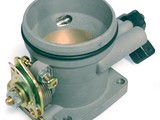

Our first article focused on the various upgrades that could be carried out on your late model Mini or Mini Cooper but stopped short of talking about horsepower upgrades. (the part 1 article can be found here) This edition will simply focus on the power unit as found in these late model Mini Coopers. The first of the factory fuel injected Mini Coopers were made available in the UK in 1991. This first edition is now most often referred to as a SPI or single point injected Mini Cooper. It is fair to say that this model represented the beginning of the end to the after market tuning business that had surrounded the Mini though out it’s history. From out perspective these days, one of the primary reasons for the historical success of the Mini brand had been the ease with which it could be upgraded, modified and personalized. One of the primary teaks applied to the many early Minis was in the area of improved engine performance. And the ability to apply many of the same techniques to the new fuel injected Mini just do not work. With the advent of the computer in our society most of us have experienced many benefits. But when this same technology was applied to the Mini we lost the ability for the do-it-yourself and even many professional mechanics to effect any real change in performance.
The factory upgrade to fuel injection was not driven by the historical desire for better performance but solely based on the desire to extend the life of a design that was approaching 40 years old. For the Mini to continue it had to be able to comply with tighter and tighter emission standards and fuel injection was the only hope. The primary market for the Mini in those days was the Japanese mainland where the emission standards were some of the highest in the world.
So what do we do about this mess? If the computer is controlling some of the most crucial functions of internal combustion motors, ignition timing and fuel delivery, how can we make effective changes without being able to change the computer. We can not do much and the old days of being able to almost double the output of any Mini motor are long gone with fuel injection. The stock SPI is not a bad driving car but as it’s heritage demands we just need a little more.
The first choice of many is of the old school that says, ‘let’s remove the catalytic converter and that will make a big improvement’! Wrong- the stock SPI is not bad in the efficiency department and thus removing it will only result in a very small gain at the very highest of RPMs. Should you do it? I would suggest that other factors in the decision are more important than HP. Does the exhaust system need changing because of age anyway? Are you looking for a more aggressive sound? Do you care if the car is no longer original? Do you care if you are tampering with a Federal emissions requirement? (although the car in this form is unlikely to be registered such that it would ever require emission testing). If you can find any second reason for removing the catalytic converter, then the answer is sure- do it.
The next steps in the potential upgrades are somewhat classic but again limited by the on-board computer. Increasing compression can only be as effective as the computer can self adjust for the increased demands for fuel and timing. Any sort of significant camshaft change also requires a change of timing and fuel. But the upgrade from the stock 1.3 ratio rockers to a modern 1.5 ratio will provide some benefits that are mild enough to be within the range of the ECU to accept. The higher ratio rocker are similar to a camshaft upgrade but can be done without pulling the motor and have a much less dramatic effect. Yes, this also means it will not have a great effect on the feel of HP on the road. You can measure it on the Dyno but will be only felt as more torque in the mid to higher RPM range. I will remind you – there are NO large gains to be had in tuning a SPI Mini.
The next potential upgrade is not as easy. The stock cylinder head is just that stock and upgrading to a head with better flow and higher compression will yield yet another smallish gain. This is for sure one of those upgrades that should be considered if you have other reason to either be that deep in the engine or the stock head needs maintenance. The cost verses benefits ratio is not high on this upgrade either but there are gains to be had at price. Heads are available from many of the tuners and when combined with exhaust upgrades, rocker ratios and upgraded air filtration will yield a bit of improved satisfaction in daily driving. PS- this will never be the choice for real high performance or race track use.
The final option that might be considered for the SPI Mini owner that would really rather have performance then fuel injection is to actually back-date the Mini to use the same SU carb set-up as on the previous generation. In contract to the last of the Minis with MPI (twin point injected), the SPI Mini still makes use of a distributor. And most importantly, the ECU (on-board computer) is not so invasive in the overall operation of the car that you can actually by-pass it functions for fuel control and ignition timing. This opens you up to any of the numerous upgrades historically applied to the 1275cc engines. The basic process to bypass the ECU and replace the fuel injection with a SU carb (or even a Weber) can be carried out by most experienced mechanics with no real problem.
The next installment of upgrades will deal with the last of the Mini production, the MPI, Multi-point (also know as TPI -twin) point fuel injected Mini.